Influence of Bedrock Seismic Action Modelling on Microzonation
Abstract
Seismic microzonation aims to characterize the Local Seismic Response (LSR) of a territory by accounting for the effects of local geological and geotechnical conditions on filtering the seismic motion at the bedrock. The reliability of the resulting microzonation therefore depends not only on the geotechnical model but also on how the seismic input at the bedrock is defined. Current practice generally relies on selecting natural accelerograms from available databases to match a target response spectrum. Although effective in the spectral domain, this approach may not adequately reproduce the time-dependent characteristics of the seismic motion expected at the site. This study investigates the influence of bedrock input-motion modelling on seismic microzonation results. Fully non-stationary artificial accelerograms are generated from the target response spectrum and from records obtained in the neighborhood of the site. Their effects on the LSR are evaluated through one-dimensional linear-equivalent site response analyses and compared with those obtained using or conventionally selected natural accelerograms, or using accelerograms recorded directly at the site. The study also highlights the extent to which the representation of the bedrock seismic input can affect, after the evaluation of LSR, the estimated nonlinear response of regular and irregular multi-story reinforced concrete frames.
Highlights
- Fully non-stationary hybrid accelerograms, generated with the Cacciola method, are used as bedrock input for one-dimensional equivalent-linear site response analyses at Norcia (2016 Central Italy earthquake).
- The hybrid inputs are compared with conventionally selected and scaled natural records, and with accelerograms recorded at the site, used as benchmark.
- Hybrid motions reproduce the surface PGA and its record-to-record variability more closely than scaled natural records, which require large scaling factors (mean 2.19).
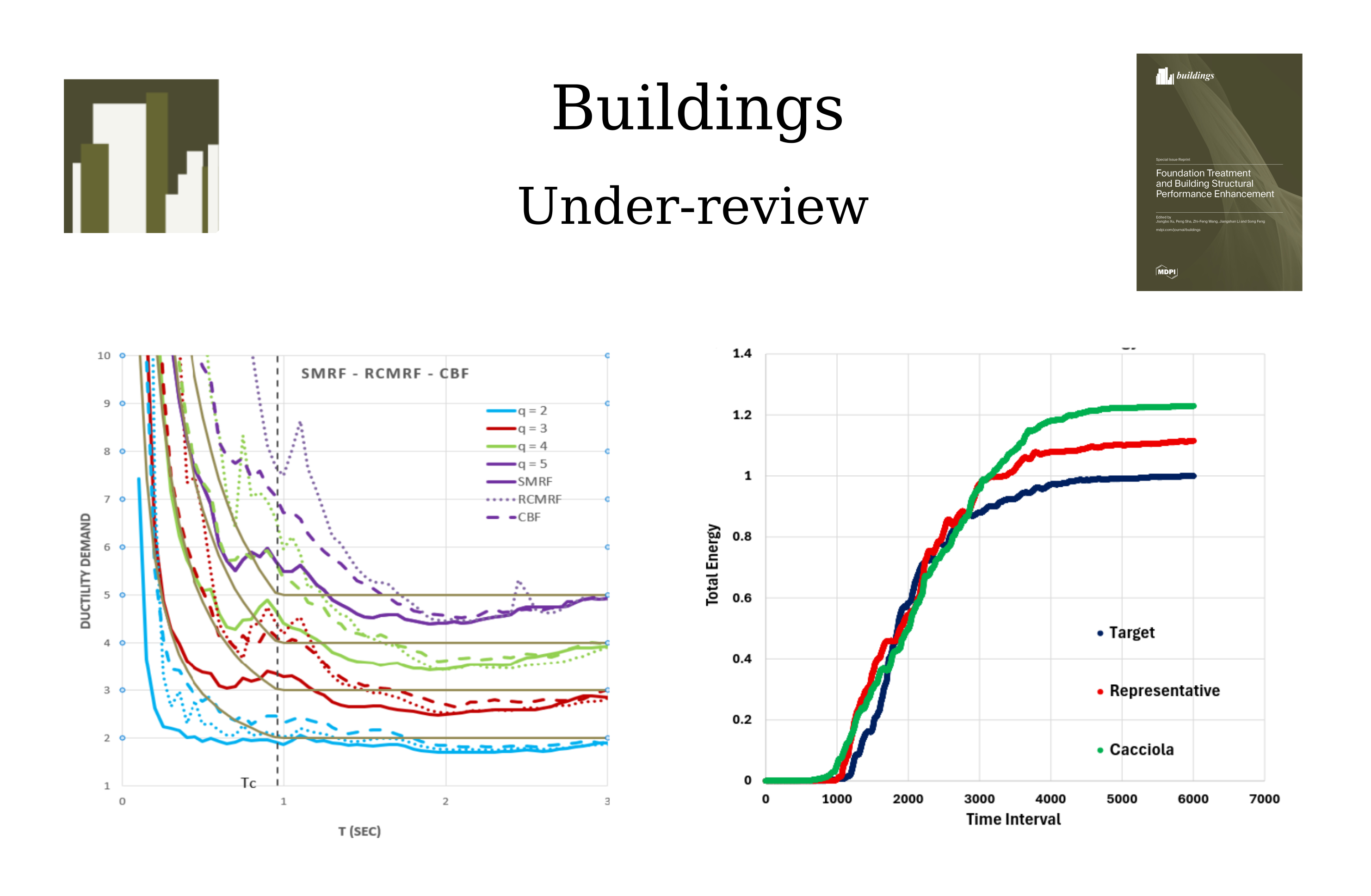
- Ductility-demand spectra for three hysteretic SDOF models show that spectral compatibility alone does not guarantee equivalent nonlinear demand, especially for pinching systems and high behaviour factors.
- Nonlinear time-history analyses of two six-storey RC buildings show that hybrid inputs closely match the benchmark interstory drift and torsional response, while scaled records overestimate it.
Publication history
- Submitted: October 2026