Closed-form biaxial curvature and ductility domains for reinforced concrete rectangular sections
Abstract
The accurate yet practical assessment of deformation capacity of reinforced concrete (RC) members under axial load and biaxial bending is a key challenge in performance-based seismic engineering. This study develops a new set of closed-form analytical expressions for the analytical approximation of the biaxial elastic curvature, ultimate curvature and curvature ductility domains of rectangular RC cross-sections. An extensive parametric dataset of curvature domains is generated, spanning a wide range of geometrical configurations, reinforcement ratios, and axial load levels. The resulting directional capacity data are then approximated using a super-ellipse equation with the shape exponents calibrated via symbolic regression using a multi-population genetic programming (GP) algorithm. The resulting closed-form equations accurately capture the complex direction-dependent nature of the domains, showing superior accuracy and generality when compared to existing formulations. The proposed model successfully balances high fidelity while maintaining computational efficiency of a closed-form solution, ensuring compactness and ease of integration into structural analysis and design tools. The results will show that the model can balance accuracy and usability for performance-based assessment, displacement-based design, and the calibration of lumped-plasticity nonlinear models of RC columns.
Highlights
- Closed-form expressions are proposed for the biaxial ultimate curvature, elastic curvature and curvature ductility domains of rectangular RC sections under axial load.
- A fiber-based parametric database was generated from 227 cross-sections. It contains 13,620 ultimate and 6,251 elastic curvature and ductility domains, covering a wide range of geometries, reinforcement layouts and axial load levels.
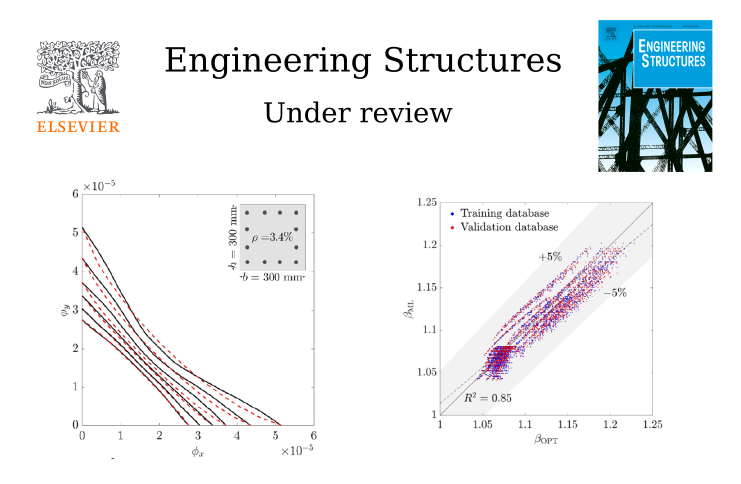
- Each domain is fitted with a super-ellipse. Its shape exponent, which controls the transition from concave to convex domain shapes, is derived by symbolic regression with multi-population genetic programming.
- Axial load level, longitudinal reinforcement ratio and rebar spacing turn out to be the key explanatory variables. The predicted exponents reach R² ≈ 0.94, 0.85 and 0.87 for the ultimate, elastic and ductility domains, respectively.
- The model is more accurate than existing formulations. Mean errors drop from 7.8% to 1.2% as the axial load ratio increases. This makes the model suitable for displacement-based design and for calibrating lumped-plasticity models of RC columns.
Publication history
- Submitted: September 2026