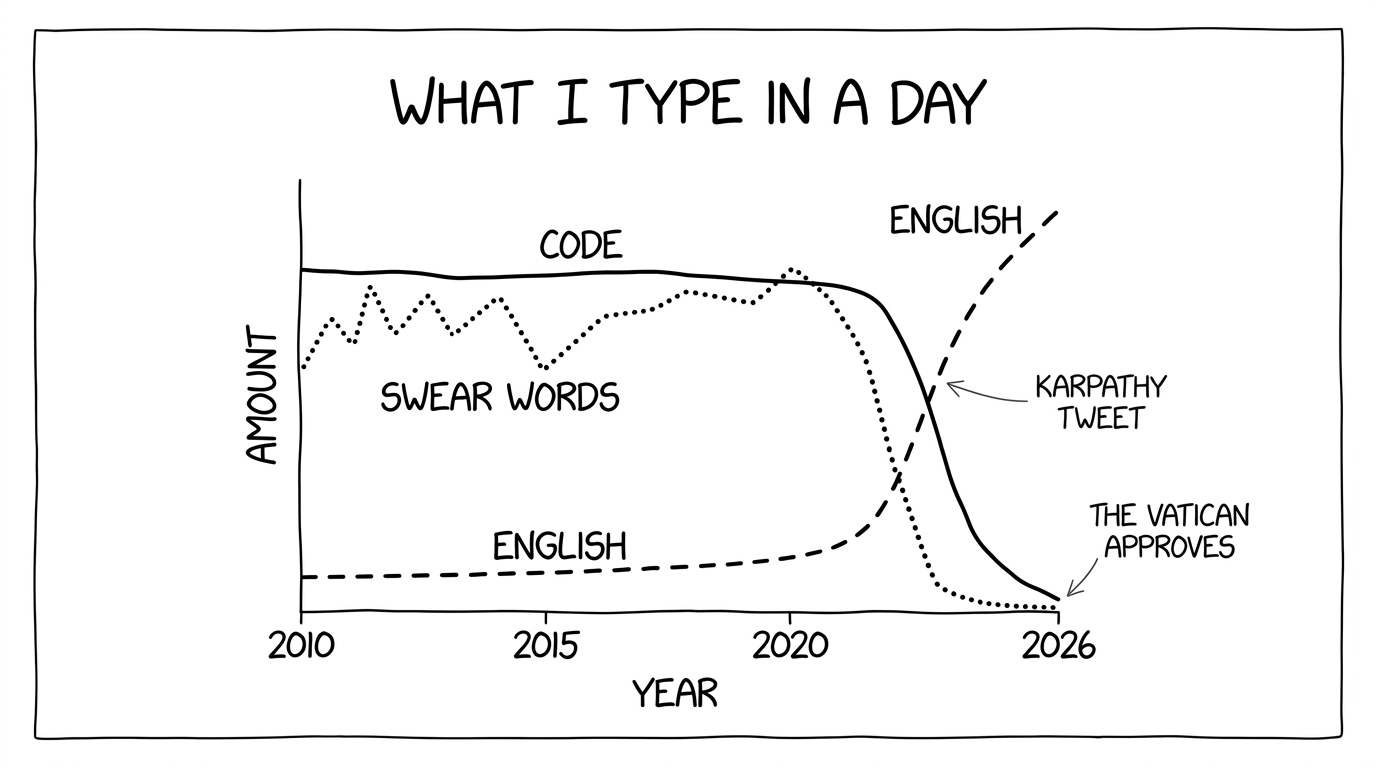
A few weeks ago I showed a professor the latest developments of the framework we are building together. Among them was something I was rather proud of: an MCP server, a layer that lets a language model use the framework directly, building models, running analyses, reading results. (How I stumbled upon MCP, and what it has been like to build one, deserves a post of its own.) He scrolled through the code for a while, frowned, and said: “But these are all English words.”
He was right. Most of what makes an MCP server work is not code in the traditional sense. It is descriptions: what each tool does, when to use it, what the inputs mean, what can go wrong. Sentences written for a reader that happens to be a machine. To structural engineers like us, whose first programming course in the first year of a bachelor’s degree was in C, it must have looked like documentation that had swallowed the program.
It took me a moment to realise that his remark described not just the file, but me.
Code without typing
I no longer write code. Not in the sense I was taught, at least. I describe what I want, I discuss the data flow, I argue about units and sign conventions, I review what comes back, and I ask for corrections. In words. The keyboard is still there, but it has become a microphone with buttons.
This is not laziness, or not only. The hard part of scientific programming was never the syntax: it was knowing what the code should do, and whether what it does is physically meaningful. That part has not gone anywhere. If anything, it is now the whole job. What has gone is the long, silent negotiation with the interpreter, the traceback read line by line until it finally made sense, the hour spent on a misplaced index, the small pleasure of a loop that finally runs.
 by Randall Munroe, CC BY-NC 2.5.](/blog/2026-on-thinking-differently-screen/xkcd_378_real_programmers.png)
In January 2023, Andrej Karpathy (his biography is worth a read) tweeted that the hottest new programming language is English. At the time it sounded like a provocation. Almost four years later, in my daily work it has become a plain description.
The idea itself is much older than the tweet. There is a whole field called natural language programming, where programs are written as structured English sentences that map, one by one and without ambiguity, onto procedures in a conventional language. Back in 1979 Dijkstra had already dismissed the whole ambition in a short essay with a title that leaves little room for doubt, On the foolishness of “natural language programming”. I will be honest: I understand only a tiny fraction of this, and I am in no position to say whether what I do every day counts as its fulfilment or as exactly the foolishness Dijkstra warned about. Probably a bit of both.
My agent’s thinking
Every programmer of a certain age knows this strip by heart. My older brother had it pinned on the wall of his room in the years he was studying computer science at university. It might still be there; I should ask my father to check.
The joke was about time. Compiling was dead time, legitimate and unchangeable, the only moment in which a programmer could do nothing without feeling guilty.
Today the strip would need a new line. “Get back to work!” “My agent’s thinking!” And yet it does not quite work, because those minutes are no longer empty. While the agent writes, I read what it wrote five minutes ago, I check the units, I prepare the next request. The waiting has not disappeared, it has changed nature: from idle time to review time. There is no corridor and no sword-fight. Unless, of course, you run the model locally, as I recently tried: then there is plenty of time for a sword-fight.
 by Randall Munroe, CC BY-NC 2.5.](/blog/2026-on-thinking-differently-screen/xkcd_303_compiling.png)
What has almost disappeared is debugging, at least as I knew it. No more staring at a stack trace late at night, no more print statements scattered through the code to find where a variable goes wrong. I describe the symptom, and the fix comes back. And this has a side effect that, I suspect, has not received the attention it deserves.
The Catholic Church has already taken up the subject of AI: in May, Pope Leo XIV published Magnifica Humanitas, his first encyclical, devoted to the human person in the age of artificial intelligence. My fiancee is reading it these days and keeps praising how beautifully it is written. My first thought was that whoever drafted it must be the same guy who “ghostwrote the Pope’s last one” (perhaps only a few Italians will get the reference to Smetto quando voglio, a movie I quote far too often, and a great one). I have not read it yet, so I cannot say whether it addresses the aspect I find most relevant. But I am confident that, once the general public grasps what agents can do, religious leaders all over the world will endorse them, if only for the dramatic drop in blasphemy and swearing among people debugging code. In Italy alone, the effect on the national balance of sins should be measurable.
The search box is empty
The same thing happened, more quietly, with search. I do not remember the last time I opened Google to look for something technical. I ask. In full sentences, with context (a lot of context, which raises questions of its own), with follow-up questions, and I expect an answer rather than ten blue links to open, skim and compare.
 by Randall Munroe, CC BY-NC 2.5.](/blog/2026-on-thinking-differently-screen/xkcd_979_wisdom_of_the_ancients.png)
For a millennial, this is not a small thing. My generation grew up learning how to google. It was a skill, and its core principle was to distill a problem into the few words most likely to appear on the page that held the answer. Choosing the right keywords, stripping a question down to its essential nouns, adding quotes, excluding terms, knowing which forum would have the answer. We spoke to search engines in a strange, telegraphic dialect, and we were good at it. Now it works the other way around: the more context you give, the better the answer. That dialect is becoming useless, like knowing how to fold a road map.
A second migration
People of my generation have already migrated once, which, I realise, is exactly how the best old-timer lectures begin. When I was in elementary school, in the middle of Sicily, school research was done on books and encyclopedias. Then came encyclopedias on CD-ROM (I can still picture the Encarta box on the shelf; the disc must be somewhere at my father’s place, though I would have nothing left to run it on :) ), then the browser. We adapted, and we were proud to be the generation that bridged the analogue and the digital worlds.
Now we are migrating again, and this time the change is less visible but, in my opinion, deeper. It is not the tool that has changed; it is the way the brain approaches the screen. In front of a computer I no longer think in commands, keywords and syntax. I think in intentions, questions and explanations. I think as if someone were listening, because someone, or something, is.
I notice it in small ways. I get impatient with software that requires me to click through menus. I phrase my own notes as if they were prompts. When something does not work, my first instinct is no longer to search for the error message, but to explain the problem to an LLM.
And, somewhat paradoxically, I read and write far more than I used to. Every day, entire blocks of answers several pages long come back to me, and I read them, all of them. In return, I write long requests, full of context, explanations and second thoughts. I used to be a man of few words in front of a screen, except in the weeks spent on proposals and papers. Now every day feels a little like one of those weeks.
No way back
Is this good? I honestly do not know. There is something lost in no longer struggling with the machine: the struggle taught us how things work underneath, because it forced us to read, dig and understand. I personally learned a great deal that way, perhaps because it was the only way to fill the gaps in my background that stood between me and a real understanding of the subject. There is also something gained: time, reach, and the possibility of building in weeks what would once have taken years. The price is that my days, and lately my weeks, are now scheduled around usage limits: the question is no longer what time it is, but how many tokens I have left.
But whether it is good is almost beside the point. Nobody goes back to the road map once they have used a navigator, even those who complain that we have lost our sense of direction. The same will happen here. We will not return to typing every line, nor to the search box with its carefully chosen keywords.
Perhaps the professor’s remark is the best summary of where we are. After decades of learning to speak the language of machines, we have finally taught them ours. The question is whether, in the process, we will forget how to speak theirs.
Illustrations not otherwise credited were generated with Gemini 3 from prompts I wrote and Claude Opus 5.5 optimized (it doesn’t come close to xkcd, who has been drawing smart stick figures smarter for twenty years; and yes, sooner or later a post illustrated with PHD Comics strips will come too). The ideas and the text are mine; the English style and grammar were polished by Claude Opus 5.5.